Every growing company hits the same wall. Revenue doubles, transaction volume triples, new entities and revenue streams appear, and the finance team stays the same size. Hiring can’t keep pace, and even when it does, it takes months to find, train, and trust a new accountant.
So the existing team absorbs the load. Reconciliations slip, close stretches longer, small errors slide through, and leadership makes decisions on numbers nobody fully trusts.
What if you could add a team member who learns your books as fast as you can teach them, works every day without burning out, and gets more accurate every month?
That’s the idea behind Zenday’s agentic AI.
An AI you onboard, not configure
Most accounting automation works like a rulebook. Someone has to write every rule in advance, and the moment something new happens (a new vendor, a new contract, a new revenue stream), the rules break and a person steps in.
Agentic AI works differently. You onboard it much like you would a new staff accountant.
You show it how your company codes transactions, which accounts matter, how you handle accruals, and what your review standards are. When it gets something wrong, you correct it, the same way you’d mark up a junior accountant’s work. It remembers that correction and applies it next time.
No coding, no complex setup, no rulebook to maintain. If your team can train a new hire, they can train Zenday.
Built around the rhythm of accounting work
Accounting doesn’t happen once a month. It runs on a cadence of daily, weekly, and monthly work, and Zenday’s agents are organized the same way.
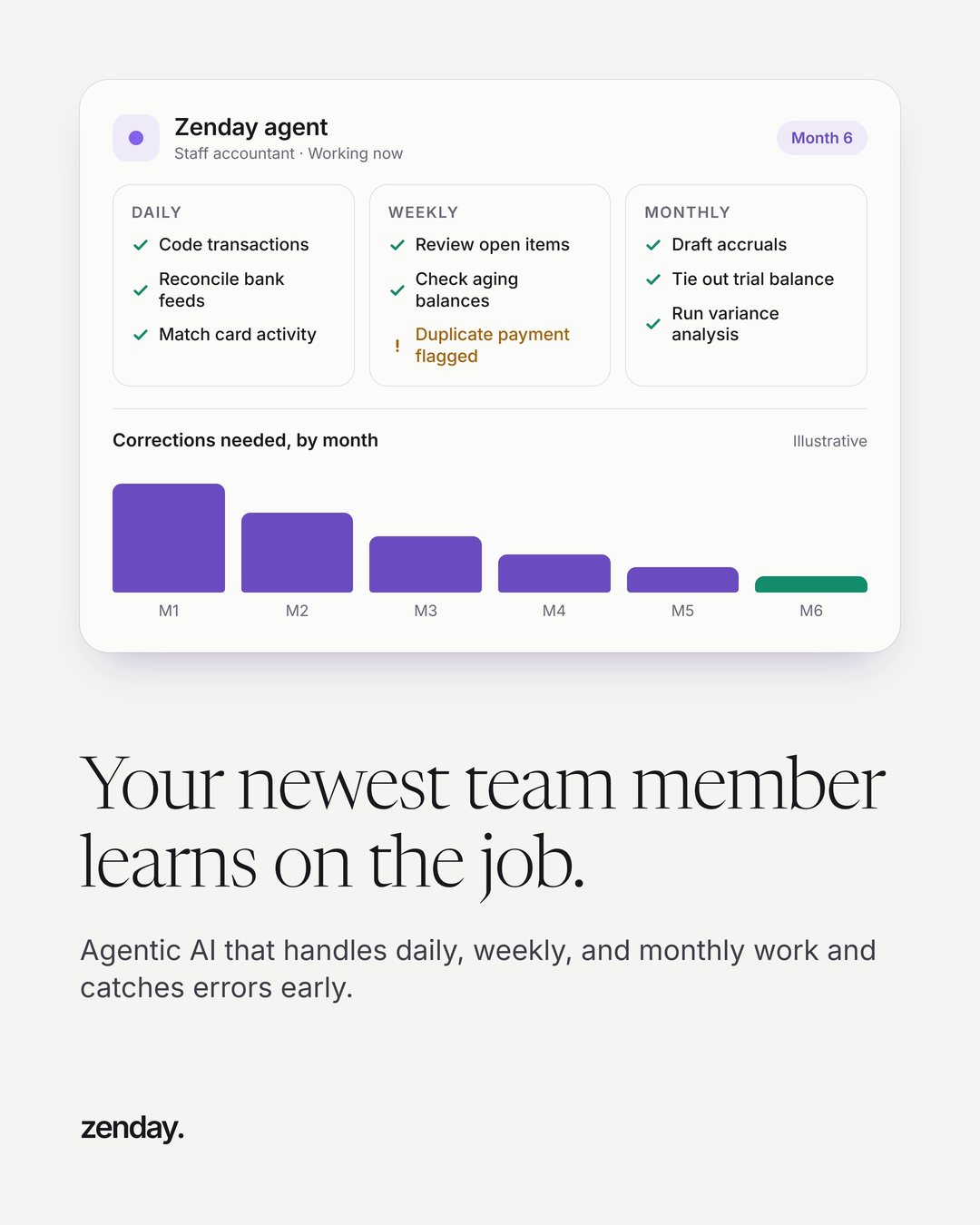
- Daily, the agents code transactions as they post, match bank, card, and payment processor activity, and reconcile accounts in real time. Anything that doesn’t fit gets flagged for review instead of piling up.
- Weekly, they review open items, follow up on unmatched transactions, check vendor and customer balances, and surface anything aging or unusual before it becomes a month-end problem.
- Monthly, they draft accruals, prepaids, and depreciation entries, tie out the trial balance, and run variance analysis against prior periods and budget. Because most of the work has already been done day by day, month-end becomes a review rather than a scramble.
Your team assigns the work, reviews the output, and approves the exceptions, exactly how a manager works with a staff accountant.
It learns from every instance
The difference between a new hire and a seasoned accountant is experience. The seasoned accountant has seen how this company’s transactions behave, knows which vendors bill irregularly, and spots when something looks off.
Zenday builds that experience the same way. Every transaction it codes, every correction your team makes, and every entry you approve becomes part of what it knows about your business. The first month, your team might review a lot. By the third or sixth month, the agents handle far more on their own, and the items they flag are the ones that truly need a person.
Unlike a staff member, that knowledge doesn’t walk out the door when someone leaves. It stays with your books.
It looks for errors before you do
Most errors in financial statements aren’t caught because no one had time to look. A duplicated vendor payment, an expense coded to the wrong department, a revenue entry that doesn’t match the contract, or an accrual that never reversed can all sit unnoticed until an auditor, an investor, or a board member finds them.
Zenday’s agents don’t wait to be asked. They proactively review the books for anomalies such as duplicate transactions, unusual amounts, entries that break from historical patterns, accounts that don’t reconcile, and balances moving in unexpected directions. When they find something, they flag it with the exact transaction and the reason it looks wrong.
The result is financials that are more accurate, caught earlier, and far less likely to surprise anyone at the end of the quarter.
Efficiency that compounds over time
Traditional automation delivers a one-time gain. You set it up, it saves some hours, and the benefit stays flat.
Agentic AI is different, because its value grows. Each month the agents learn more about your business, handle more of the routine work independently, and need fewer corrections. Your team’s review time drops, accuracy improves, and the capacity you free up keeps growing.
That’s the opposite of how most finance teams experience growth, where more volume usually means more strain.
Built for high growth with scarce resources
Fast-growing companies rarely have the luxury of a large finance team. They need accurate numbers to raise capital, manage cash, and make decisions, but they can’t hire ahead of growth.
Zenday lets a lean team operate like a much larger one. Transaction volume can grow without close growing with it. New entities and revenue streams can be onboarded by teaching the agents rather than hiring and training new staff. And because the books are closed through today, leadership always has current numbers to work with.
For accounting firms, the same advantage applies across a client base: more clients served with the same team, and more time for advisory work.
The bottom line
The most valuable person on a finance team is the one who knows the business, catches problems early, and gets better every month. Zenday brings that same profile to your books, as an AI team member that is easy to train, works every day, and grows with you.
Your team stays in charge. Zenday does the work, learns from every correction, and keeps watch for errors. Growth no longer has to mean overtime.
See how Zenday’s AI team takes on daily, weekly and monthly work, and how your team reviews it.
The AI team